Back when I was lusting over a Triump Street Triple R, one of the things that swayed me away from a superbike and into a V-Strom was imagining the kind of riding I'd really like to do. The S3R was a sexy bike, no doubt about that, but when I was really honest with myself, I knew that the Triumph wasn't engineered with Alaska's frost heaves and gravel roads in mind. Now, 14,000 miles (and change) later, I am more convinced than ever that the Wee-Strom was a much better bike for me than the Triumph (although I still want to own an S3R...eventually :)
One of the trips that I wanted to make that helped steer me away from the Triumph was a trip over Hatcher's Pass, near Palmer. The beginning of the ride on the Palmer side of the Pass follows the Little Susitna River, a shallow, splashy creek that meanders through the valleys in the foothills of the Talkeetna Mountains. The Triple would be loads of fun here, as the road follows the curves that the creek has carved in the bedrock of the Talkeetnas. However, there is much more to Hatcher's Pass than the few miles of twisties along the Little Su. In fact, most of the road over Hatcher's Pass is gravel 1 1/2 lane. I had never driven the pass all the way through from Palmer to Willow, but I wanted to, very badly. Once I started motorcycling, I knew I had to ride this route on a bike. Unfortunately, a naked supersport is hardly the ideal steed for such a ride, and so this helped me decide upon the V-Strom, an ideal bike for both the paved twisty sections near the Little Su and the gravel stretch over the top of the pass.
Yesterday morning, July 8th, dawned bright and clear, although still rather chilly, even by Anchorage standards. Nevertheless, I donned my riding leathers -- no Kevlar-lined denim on this trip; I wanted full CE-approved armor for the exploring I had in mind -- and hit the road around 10:00. By eleven, I was huddled next to the fireplace at the Starbuck's in Palmer, sipping on a mocha and reading a couple of chapters from Ghost Rider by Rush drummer and ADV motorcyclist Neil Peart (a good read, though understandably melancholy at times) as I tried to warm up. About a half hour later, I was back on the road, and soon I was in the aforementioned twisties, behind a Subaru wagon, which was actually sustaining a much better pace through the curves than one might imagine.
As we approached the hairpin turn that signalled the road's departure from the Little Su, I greatly increased the spacing between myself and the Subaru. While the driver had done a surprisingly acceptable job so far, we were approaching the tightest turn on the road, and I wanted to have enough breathing room to enjoy it. The Subaru slowed, turned, and accelerated up the straightaway on the far side of the curve, and moments later, I followed, leaning the bike to the left, hanging off the side, knee out...and what is that rumbling I feel in my left foot? What is that horrid scraping noise? Did I just...uh...yep, I think I did. I've touched my toes to the pavement a couple of times when heeling the bike over hard on a sharp turn, but was the first time I had ever dragged a footpeg...at least on my Strom. I had dragged the pegs on my wife's S40 Boulevard and I had even dragged a peg during my MSF course, eliciting a thumbs-up and a smile from the ex-racer riding coach, but my V-Strom has much greater ground clearance than either of those bikes. I barely had time to crack a smile at (finally!) touching a footpeg on the turn when I reached a side road I wanted to ride.
Shortly before earning my motorcycle endorsement, I discovered another road for which the S3R is even less suited. Wa-a-a-ay back when my Nissan Frontier was just barely broken in, my two brothers and I packed up our backpacks and set out in my truck for an overnight hiking/camping trip in Archangel Valley. While it was a fun trip, at least for the two of us in the front seat (sorry, Nick!), I started daydreaming about returning to Archangel Valley on a bike. I thought that it would be even more fun on the Wee than it had been in my pickup.
I had no idea :)
The road itself is a narrow, rocky, pot-holed, winding trail that leads from the main road in Hatcher's Pass up to an old, abandoned mine. Rusty mining equipment and old mine shafts with beard-like tailings cascading down the mountain sides give mute testimony to Hatcher Pass's rich (in either sense of the word) history. However, today, hiking and exploring the mines was not foremost on my mind -- far from it. I was here to ride, and ride I did.
The road itself was relatively dry, although the bottoms of most of the potholes were filled with mud puddles. I splashed my way over, around and through the puddles, dodging the deeper, steeper holes, and weaving around the larger boulders that stabbed through the packed surface of the dirt road. Even with a nearly bald rear tire, I was able to comfortably maintain between 25 and 35 MPH...until I caught up with a 4x4 pickup picking his way through the minefield of granite and mud at more like 5-10 MPH. I paced him for awhile until we reached a slightly wider part of the road and he waved me past. Soon, I caught up with another 4x4, and then another. Wash, rinse, repeat.
I was picking my way around another mud puddle when I noticed something in the road. That's odd, I thought to myself. It looks like something peed on the road, but what pees BLACK? That's when I realized someone was having -- or was about to have -- a VERY bad day:
That wasn't pee -- it was motor oil. Someone had bottomed out, but they hadn't had the ground clearance to avoid a rock, and they had punctured the oil pan. I raced up the road, hoping that I could catch the victim before they seized their engine. A short distance later, I saw a VW Jetta picking it's way over the road, and sure enough, the oil trail marked it's passage around the obstacles on the road. Catching up to it, I could see the oil draining from underneath the car. I honked, saw the driver look up in his rear-view mirror and pulled up beside him.
"Dude, you're leaking oil from under your car. Did you bottom out a little ways back?" I asked.
"Yeah, but I didn't think I hit that hard," he replied. He pulled over, shut off the engine and looked underneath the car. He muttered a few choice words under his breath. "How am I going to get back out of here?" he wondered aloud. About that time, a truck that had just passed going the other way stopped, and the driver walked back up to where we were. The driver of the truck, the driver of the Jetta, and the passenger in the Jetta chatted for a few minutes, then the guy from the truck offered to give the two from the Jetta a lift back to Palmer where they could call for help. I continued on up the road after loosening the pre-load on my rear shock one full turn and letting about 5 PSI out of my tires -- something I should have done as soon as I left the pavement.
The rest of the ride up and back out of Archangel Valley was uneventful, but arguably the most fun I've ever had on my V-Strom -- and certainly the most fun I've had since last year's Denali Highway trip. By the time I reached the main road going over the pass, I was sweating and my back was mildly sore from stooping over to reach the handlebars while standing on the footpegs. I didn't care; inside my helmet, I was wearing a grin a mile wide.
After leaving Archangel Valley, I continued up to the summit of the pass, beyond Independence Mine, the farthest point I had ever gone. I didn't realize how close to the summit the mine was, so I was very surprised to reach Summit Lake within just a couple of minutes.
Yes, the date was really July 8th, and yes, there was still ice in Summit Lake. We received a record snowfall in Anchorage last winter, and while the rest of the country has posted record high temperatures, the summer so far in south-central Alaska has been unusually cool. I can count on one hand the number of days that I've had the insulated liner out of my jacket. I've ridden most days with my insulated gloves rather than my summer gloves so far. I've even had the heated grips on more often than not this year. Therefore, I wasn't surprised to see ice in the lake.
A short ways down the pass from the summit, I saw an interesting looking side road, and decided to see where it lead. Similar to Archangel Valley, this unnamed road (Google Maps suggests that it's Upper Willow Road, but it wasn't marked) was a narrow, rocky, winding road through what appears to be a glacial valley. This road, however, does not see the same traffic as Archangel Valley, and the rocks along the route are larger and looser than the road I rode earlier, and the road itself is narrower. I had a blast...until I caught a face full of tiny black flies while my visor was up, lol. The air blowing through my helmet was refreshing. The bugs blowing through my helmet, however...not so much.
This road is also shorter than the road into Archangel Valley, so I soon reached the end, and reversed course to rejoin the main road down the pass into Willow. Even though the road was in pretty good shape and wide enough for two cars to pass side by side (albeit, slowly), I found I was still riding at a, ahem, somewhat "accelerated" pace compared to the cagers around me. Many of them would pull to the right and wave me around them as I would catch up, a couple of them I passed when I saw a likely opportunity without waiting for a signal to pass.
Incidentally, if the guy in the cool, yellow, vintage LandCruiser happens to find this post, I apologize for revving my engine as I passed you. It wasn't intentional; my motorcycle dropped out of second gear and into neutral as I rolled on the throttle, an annoying bad habit it has recently acquired. On the other hand, to the dude in the Chevy pickup, weaving all over the road while holding a pocket-sized video camera to your head -- I sincerely hope the life you eventually end up taking doesn't belong to an innocent driver coming the other way, or to a passenger in your rig (hint, hint).
Finally, nearing the bottom of the pass on the Willow side, I encountered a broad, open vista spanning as far as I could see around me. I pulled off on the side of the road, retrieved my camera, looked through the viewfinder...and put it away. Just like on the Denali last year, I realized that such grandeur requires a far larger format than my Canon Powershot. There is no way to catch beauty on such a scale in a digital image; once again, I would have to be content with memories. Hmmm...maybe I just need to make another trip up the pass with my wife and daughter soon? :)
Monday, July 9, 2012
Wednesday, June 27, 2012
What is Adventure?
What does it take to make a motorcycle trip an "adventure?" If you look around the motorcycle market, there's no shortage of "adventure" or "adventure touring" motorcycles. In the three years since I bought my Wee-Strom, Yamaha has introduced the Super Tenere to the U.S. market, Triumph down-sized the (arguably sport-touring, rather than adventure touring) Tiger 1050 into the Tiger 800 and the Tiger 800XC, and even Honda is trying to get a piece of the action with two new "cross-over" models, even though they are more street bike than even the Strom.
All of this interest in "adventure" bikes begs the question, however: what exactly is "adventure touring?" Is a ride an "adventure" if you are only on a day trip, or must you at least be gone overnight? A weekend? Two weeks or longer? What about road conditions? Perhaps you must spend the night under the stars somewhere before you can honestly call the ride an "adventure?" Is the length of the ride the determining factor? Maybe one can only claim an adventure ride if it involves at least one international border crossing? All of these, I would think, have a bearing on whether or not a ride is an adventure.
Consider two extremes: "Jupiter's Travels" and "Dreaming of Jupiter" are two books written by bonified adventure tourer Ted Simon, documenting his two trips around the world by motorcycle. By any measurement one might care to use, these two trips are undoubtedly "adventures." At the other extreme, in "Alaska by Motorcycle" Dr. Greg Frazier tells the story of a couple who load their Harley-Davidson's onto the Alaska Ferry in Seattle, then try to buy "I Rode My Harley to Alaska" t-shirts at Anchorage House of Harley. That's not exactly the type of trip I dream about, but hey, whatever floats your boat. So where does the scale tip from an ordinary ride to an "adventure?"
Consider duration of the trip first. Earlier this year, I took a morning ride to a nearby 4x4 trail. This trail is steep, rocky and rutted. Furthermore, when I took my V-Strom up the trail early this year, I was stopped less than a half-mile up the trail due to snow:
The entire round trip from my house, up the trail and back, was less than an hour in duration, but I was pushing myself, and my bike, as hard as I dared. Was this trip an "adventure?"
Speaking of road conditions, is it possible to have an "adventure" on macadam, or must you ride on dirt at least once during the trip? If so, does a well-maintained gravel road count? Two-track? Maybe a ride doesn't count unless you are on single-track? If road conditions are the only qualification, then the hour ride I described above must surely qualify, but are road conditions the difference between an adventure and an average ride? Are road conditions even relevant? Even though most of the Alaska Highway is paved now, it seems to me that anyone riding from the lower-48 to Alaska on a motorcycle has certainly earned the right to use the "adventure" label.
But is that only because there are still gravel portions on the road, or is it that a trip up the Al-Can is a multi-day trip? Does a trip up the Al-Can even qualify? How much of an adventure is it for a couple on a GoldWing, sleeping in a nice hotel every night, eating three squares a day in restaurants and pulling a trailer with all of the necessities that they cannot live without behind them? To me, that sounds more like luxury touring than adventure touring!
Then again, maybe the same couple, on the same GoldWing would have more of a claim to the adventure moniker if they slept under the stars, eating freeze-dried camping food? In that case, does a pop-up trailer count, or must you sleep in a tent or bivy sack? But again, this definition fails to satisfy. A couple of weeks ago, I took my Wee-Strom for a season shake-down overnighter to Burma Landing. Although bad weather made for a rough trip -- I was pretty cold by the time I got home, despite heated grips and Thinsulate-lined gloves -- I would be embarrassed to call the trip an "adventure." I was still in my own back yard, figuratively speaking, even if I had to drive an hour and a half out of the way to get there!
One might claim that a trip isn't really an adventure unless you make at least one border crossing, in which case, the hypothetical couple on the GoldWing are set, and my trip to Burma Landing is not remotely an "adventure." However, even that definition is open to argument. Certainly riding from Deadhorse to Ushaia qualifies, but what about a ten minute ride from a German border town down the Autobahn to a French border town on a BMW S1000RR? Is such a ride more an "adventure" than my overnight trip on the Denali Highway in Alaska last year simply because of a single border crossing? (Okay, yes, simply riding an S1000RR on the Autobahn would be an adventure in my book, but that's not the kind of adventure I am talking about in this context ;)
Maybe the problem is that, in all of what I have written above, I am speaking in absolutes. That is, I am asking the question, "What factor determines whether a trip is or is not an 'adventure'" when instead, I should be discussing "adventure" in terms of degrees. Can I honestly say that the couple who ferried their bikes to Alaska didn't have an adventure, at least by their standards? Even if I would, would I still argue that point if I found out that they were 70 years old, and had spent their entire lives within 20 miles of the place of their birth?
Perhaps there is no line in the sand where one can say "this side of the line is adventure; that side is not." Perhaps it is all a study in shades of grey, instead. While I probably would not call my hour trip up the 4x4 trail nor my shake-down ride to Burma Landing "adventures" both trips certainly had characteristics of an adventure. To me, last year's Denali Highway trip seems to qualify, but would I stack that trip up as an example next to Ted Simon's, Greg Hedstead's or Alissa Clickenger's travels (answer: "no")?
Finally, does it even really matter? Ultimately, I don't ride for bragging rights. I ride to enjoy being out in nature. I ride to put away the cares and stress of my job, of daily life. I ride to go places I have never been and see things I have never seen. Not one of those things is in the least bit affected by whether or not the motorcycling community slaps the "adventure" label on any particular trip.
All of this interest in "adventure" bikes begs the question, however: what exactly is "adventure touring?" Is a ride an "adventure" if you are only on a day trip, or must you at least be gone overnight? A weekend? Two weeks or longer? What about road conditions? Perhaps you must spend the night under the stars somewhere before you can honestly call the ride an "adventure?" Is the length of the ride the determining factor? Maybe one can only claim an adventure ride if it involves at least one international border crossing? All of these, I would think, have a bearing on whether or not a ride is an adventure.
Consider two extremes: "Jupiter's Travels" and "Dreaming of Jupiter" are two books written by bonified adventure tourer Ted Simon, documenting his two trips around the world by motorcycle. By any measurement one might care to use, these two trips are undoubtedly "adventures." At the other extreme, in "Alaska by Motorcycle" Dr. Greg Frazier tells the story of a couple who load their Harley-Davidson's onto the Alaska Ferry in Seattle, then try to buy "I Rode My Harley to Alaska" t-shirts at Anchorage House of Harley. That's not exactly the type of trip I dream about, but hey, whatever floats your boat. So where does the scale tip from an ordinary ride to an "adventure?"
Consider duration of the trip first. Earlier this year, I took a morning ride to a nearby 4x4 trail. This trail is steep, rocky and rutted. Furthermore, when I took my V-Strom up the trail early this year, I was stopped less than a half-mile up the trail due to snow:
The entire round trip from my house, up the trail and back, was less than an hour in duration, but I was pushing myself, and my bike, as hard as I dared. Was this trip an "adventure?"
Speaking of road conditions, is it possible to have an "adventure" on macadam, or must you ride on dirt at least once during the trip? If so, does a well-maintained gravel road count? Two-track? Maybe a ride doesn't count unless you are on single-track? If road conditions are the only qualification, then the hour ride I described above must surely qualify, but are road conditions the difference between an adventure and an average ride? Are road conditions even relevant? Even though most of the Alaska Highway is paved now, it seems to me that anyone riding from the lower-48 to Alaska on a motorcycle has certainly earned the right to use the "adventure" label.
But is that only because there are still gravel portions on the road, or is it that a trip up the Al-Can is a multi-day trip? Does a trip up the Al-Can even qualify? How much of an adventure is it for a couple on a GoldWing, sleeping in a nice hotel every night, eating three squares a day in restaurants and pulling a trailer with all of the necessities that they cannot live without behind them? To me, that sounds more like luxury touring than adventure touring!
Then again, maybe the same couple, on the same GoldWing would have more of a claim to the adventure moniker if they slept under the stars, eating freeze-dried camping food? In that case, does a pop-up trailer count, or must you sleep in a tent or bivy sack? But again, this definition fails to satisfy. A couple of weeks ago, I took my Wee-Strom for a season shake-down overnighter to Burma Landing. Although bad weather made for a rough trip -- I was pretty cold by the time I got home, despite heated grips and Thinsulate-lined gloves -- I would be embarrassed to call the trip an "adventure." I was still in my own back yard, figuratively speaking, even if I had to drive an hour and a half out of the way to get there!
One might claim that a trip isn't really an adventure unless you make at least one border crossing, in which case, the hypothetical couple on the GoldWing are set, and my trip to Burma Landing is not remotely an "adventure." However, even that definition is open to argument. Certainly riding from Deadhorse to Ushaia qualifies, but what about a ten minute ride from a German border town down the Autobahn to a French border town on a BMW S1000RR? Is such a ride more an "adventure" than my overnight trip on the Denali Highway in Alaska last year simply because of a single border crossing? (Okay, yes, simply riding an S1000RR on the Autobahn would be an adventure in my book, but that's not the kind of adventure I am talking about in this context ;)
Maybe the problem is that, in all of what I have written above, I am speaking in absolutes. That is, I am asking the question, "What factor determines whether a trip is or is not an 'adventure'" when instead, I should be discussing "adventure" in terms of degrees. Can I honestly say that the couple who ferried their bikes to Alaska didn't have an adventure, at least by their standards? Even if I would, would I still argue that point if I found out that they were 70 years old, and had spent their entire lives within 20 miles of the place of their birth?
Perhaps there is no line in the sand where one can say "this side of the line is adventure; that side is not." Perhaps it is all a study in shades of grey, instead. While I probably would not call my hour trip up the 4x4 trail nor my shake-down ride to Burma Landing "adventures" both trips certainly had characteristics of an adventure. To me, last year's Denali Highway trip seems to qualify, but would I stack that trip up as an example next to Ted Simon's, Greg Hedstead's or Alissa Clickenger's travels (answer: "no")?
Finally, does it even really matter? Ultimately, I don't ride for bragging rights. I ride to enjoy being out in nature. I ride to put away the cares and stress of my job, of daily life. I ride to go places I have never been and see things I have never seen. Not one of those things is in the least bit affected by whether or not the motorcycling community slaps the "adventure" label on any particular trip.
Monday, April 30, 2012
Spring Shakedown Ride
There's a joke in the corner of the country where I live: "What do you call two days of cold, windy rain that follow immediately after five days of warm, beautiful sunshine? A weekend." All last week, I would get up in the morning, put on my motorcycle gear and commute to work, just barely resisting the temptation to call my boss en route and tell him that I wouldn't be in today. He would understand; he rides, too.
Last Thursday was the worst. My daughter had a field trip to Kenai, and I had the day off so that I could help chaperone her trip. We left Anchorage at 6:00 a.m., driving along the scenic Turnagain Highway into the mountains on the Kenai Peninsula. I had considered taking the Wee since I was going to be driving my own vehicle, and Kylie (my daughter) wanted to ride the bus with her friends. The Wee gets much better gas mileage than my Nissan truck, so the bike would be a lot less expensive to ride on the 300 mile round trip. However, the temperatures on my ride to work in the morning had been in the mid to upper 30's (F), so I was concerned about being too cold on the way to Kenai, since we would be leaving even earlier and would be riding through the mountains. Furthermore, I had been through Turnagain Pass yet this season, so I didn't even know if the pass was ice-free yet. Consequently, I wimped out and took the truck. Needless to say, it was a picture perfect day -- not a cloud in sight, and I spent the entire day in the truck wishing I was on the bike, although that's arguably better than being on the bike, wishing I was in the truck ;)
All day Friday, I was eagerly awaiting the weekend. Saturday morning, I was going to get up early, jump on the bike, and head back into the pass on the Suzuki. Although the roads were clear, there was lots of snow on the ground in the pass, which I thought would make for some cool photos of the Wee. The light, when we stopped in the pass on Thursday, was fantastic, so I planned to get up early on Saturday morning and be in Turnagain Pass by about 7:30 a.m.
I actually left Anchorage about 9:15.
With only a half tank of gas.
Under grey, gloomy, overcast skies.
As I passed Girdwood, about 30 miles south of Anchorage, it was raining and I was down to a third of a tank of gas. The Wee gets pretty good gas mileage, the pass isn't that far from Girdwood and, having other engagements later in the afternoon, I was becoming pressed for time. Consequently, I decided not to stop at Girdwood as I had planned when I left Anchorage. By the time I reached Portage, another ten miles away, I was down to one bar of gas on my gauge, I was cold and I was frustrated. The pass looked socked in, meaning I wouldn't be able to get any good pictures anyway, so I pulled a U-turn at the turn-out to Portage and returned to Girdwood, heated grips turned up to max, and huddled down over my gas tank to minimize wind resistance. After topping off the gas tank with 4.9 gallons of $4.49 gasoline (meaning that I had almost a gallon left -- more than enough gas to get to the pass and back), the ride back to Anchorage was uneventful. At Potter Marsh, I took the "international route" back home, going up the seriously fun switchbacks of Potter Heights Drive, before crossing Finland, Portugal, Romania and Bulgaria ("-Drives," lol) en route to my Anchorage home.
Fortunately, with the exception of Romania, the "international route" is composed of gravel roads that are more like lower-48 fire roads than residential city streets. Finland, in particular, is a rough, pot-holed gravel road, often with deep puddles from snowmelt and run-off, and Portugal...well, Portugal scared the crap out of me the first time I took this route home. It's a steep curve across the saddle overlooking Potter Ravine Park. Like Finland, Portugal has run-off flooding the road at the low point of the saddle, which eventually dumps into the creek that carved Potter Ravine.
Although the weather in Turnagain Pass looked to be pretty miserable, I managed to snap some photos of the bike on some of the international roads:
The ride didn't turn out quite the way I had planned, but it was still a great way to kick off the riding season.
Last Thursday was the worst. My daughter had a field trip to Kenai, and I had the day off so that I could help chaperone her trip. We left Anchorage at 6:00 a.m., driving along the scenic Turnagain Highway into the mountains on the Kenai Peninsula. I had considered taking the Wee since I was going to be driving my own vehicle, and Kylie (my daughter) wanted to ride the bus with her friends. The Wee gets much better gas mileage than my Nissan truck, so the bike would be a lot less expensive to ride on the 300 mile round trip. However, the temperatures on my ride to work in the morning had been in the mid to upper 30's (F), so I was concerned about being too cold on the way to Kenai, since we would be leaving even earlier and would be riding through the mountains. Furthermore, I had been through Turnagain Pass yet this season, so I didn't even know if the pass was ice-free yet. Consequently, I wimped out and took the truck. Needless to say, it was a picture perfect day -- not a cloud in sight, and I spent the entire day in the truck wishing I was on the bike, although that's arguably better than being on the bike, wishing I was in the truck ;)
All day Friday, I was eagerly awaiting the weekend. Saturday morning, I was going to get up early, jump on the bike, and head back into the pass on the Suzuki. Although the roads were clear, there was lots of snow on the ground in the pass, which I thought would make for some cool photos of the Wee. The light, when we stopped in the pass on Thursday, was fantastic, so I planned to get up early on Saturday morning and be in Turnagain Pass by about 7:30 a.m.
I actually left Anchorage about 9:15.
With only a half tank of gas.
Under grey, gloomy, overcast skies.
As I passed Girdwood, about 30 miles south of Anchorage, it was raining and I was down to a third of a tank of gas. The Wee gets pretty good gas mileage, the pass isn't that far from Girdwood and, having other engagements later in the afternoon, I was becoming pressed for time. Consequently, I decided not to stop at Girdwood as I had planned when I left Anchorage. By the time I reached Portage, another ten miles away, I was down to one bar of gas on my gauge, I was cold and I was frustrated. The pass looked socked in, meaning I wouldn't be able to get any good pictures anyway, so I pulled a U-turn at the turn-out to Portage and returned to Girdwood, heated grips turned up to max, and huddled down over my gas tank to minimize wind resistance. After topping off the gas tank with 4.9 gallons of $4.49 gasoline (meaning that I had almost a gallon left -- more than enough gas to get to the pass and back), the ride back to Anchorage was uneventful. At Potter Marsh, I took the "international route" back home, going up the seriously fun switchbacks of Potter Heights Drive, before crossing Finland, Portugal, Romania and Bulgaria ("-Drives," lol) en route to my Anchorage home.
Fortunately, with the exception of Romania, the "international route" is composed of gravel roads that are more like lower-48 fire roads than residential city streets. Finland, in particular, is a rough, pot-holed gravel road, often with deep puddles from snowmelt and run-off, and Portugal...well, Portugal scared the crap out of me the first time I took this route home. It's a steep curve across the saddle overlooking Potter Ravine Park. Like Finland, Portugal has run-off flooding the road at the low point of the saddle, which eventually dumps into the creek that carved Potter Ravine.
Although the weather in Turnagain Pass looked to be pretty miserable, I managed to snap some photos of the bike on some of the international roads:
The ride didn't turn out quite the way I had planned, but it was still a great way to kick off the riding season.
Saturday, April 21, 2012
Last of the Winter Accessories
Here is the last of the new accessories I picked up over the winter for the Wee-Strom:
That's my grandson Clark in the baby seat. He was born last September 22, missing my wife's birthday by a matter of hours :(
For those of you about to get up in arms about taking a baby on a motorcycle, if you notice, I'm not wearing all my gear. This was staged just for the photo; his mom was just out of the frame to the right of the photo, laughing (well, more like rolling her eyes, lol).
Sunday, April 15, 2012
DIY Tool/Fuel Tube
One of the reasons I bought the V-Strom is its range. The 2009 DL650 has a 5.8 gallon gas tank, and my experience so far says the DL650 gets an average of 43.6 miles per gallon, for a total range of 231 miles (with a 1/2 gallon reserve). However, sometimes in Alaska, gas stations can be quite a ways apart, and you never know for certain if the next gas station will be open when you arrive since many of them are seasonal. If you are out for an early or late season ride, will your planned fuel stop at 220 miles still be open? Will you have enough range to backtrack to the last open gas station if it's not? So I started looking around for options for some additional gasoline, just in case.
My ideal solution is Peg-Packer. Available in one or two gallon sizes, this looks like a great way to add range without raising the center-of-gravity of an already top-heavy bike. Unfortunately, my budget for goodies is pretty much spent this year. Another, more affordable, option that I found is the Mega-Tube Fuel Combo. This looks like a really nice solution, and it's roughly 1/3 the cost of the Peg-Packer (although, it carries 1/4 the gas, so arguably, the Peg-Packer is the better deal).
However, I've already got several MSR fuel bottles from 11 oz. to 22 oz. for my dual-fuel camping stoves and lanterns. How hard would it be to roll my own Tool/Fuel tube? I went to my local Lowe's to find out. Here's what you need to buy, if you want to try it yourself:
Materials List:
Procedure:
First, measure the length of the fuel/tool tube. I wanted mine to be large enough to carry a 22 oz. and an 11 oz. fuel bottle, so I laid the ABS pipe on a shelf next to two fuel bottles stacked end-to-end.
Next, test fit the tube on your bike.
Scuff up the ends of the tube with some sandpaper so the cement will adhere better. Scuff up the inside of the end cap, as well.
Make sure you are using the right kind of cement for your tubing. I am using black ABS tubing, so I bought ABS cement.
Smear some cement on the outside of the tube where the cap will go, and on the inside of the end cap. Make sure all of both surfaces are coated, but don't use so much that it runs or creates globs of cement. You want a thin, even coat on both surfaces.
Twist the end cap as you slide it into place on the end of the tube. Make sure it is pressed as far onto the tube as it will go.
Scuff up the outside of the other end of the ABS tubing and the inside of the coupler. Smear some cement on the tubing and the inside of the coupler, then press the coupler over the end of the tube, again, twisting it slightly as you press it into place...
...like so.
This cap comes in two pieces: a threaded end cap, and a plug that screws into the end cap. Scuff the outside of the end cap, smear some cement on it, smear some cement on the inside of the other half of the coupler, and press the end cap into the coupler. You guessed it -- give it a little twist as you push it in place.
Here is the completed tool/fuel tube.
Here is the tool/fuel tube fixed in place on my left-hand side carrier with zip-ties. I'll try to find some padded aluminum straps to permanently attach the tube, but for now, this should work.
Edit: I've had the tool tube on the bike for almost a work-week now, and I have found two problems with my design so far. First, by making it large (long) enough to carry two fuel bottles, I have a bit of a problem. If you have two bottles in the tube, retrieving the top bottle is trivial...but what about the bottom bottle? How do you reach a fuel bottle that is halfway down the tube? A three inch diameter tube is too small for my hands to fit inside. To solve this problem, I am thinking about incorporating some kind of leash or strap inside the tube that will either fit under the bottle or through the lid that you can use to pull the bottle out. While carrying a water bottle to work this week, I have used a length of copper wire (it was handy...), but I started using it like a spring until this morning, when it got crushed into the bottom of the tube. Now the copper wire *AND* my water bottle are trapped at the bottom of the tool tube :banghead:
Second, I picked up a 33 oz. MSR fuel bottle at the local outdoors shop since I want the most distance possible with the bike. Unfortunately, the new MSR bottle is about 1/16 inch too wide to fit into the tube. It is so close, but won't quite fit. The ABS tube is stout enough, I am thinking of gluing some sandpaper onto the tapered top of the bottle, then using it to grind away enough width on the tube for the larger size bottle to fit, but I'm not certain it's worth the effort. As is, I can fit a 12 oz. bottle and a 22 oz. bottle into the tube, so maybe I'll just use the tube to carry them, and if I am really worried about range (say on a ride to Deadhorse), I'll strap the 33 oz. bottle to the top of my Pelican cases, giving me almost a half gallon of extra gas.
My ideal solution is Peg-Packer. Available in one or two gallon sizes, this looks like a great way to add range without raising the center-of-gravity of an already top-heavy bike. Unfortunately, my budget for goodies is pretty much spent this year. Another, more affordable, option that I found is the Mega-Tube Fuel Combo. This looks like a really nice solution, and it's roughly 1/3 the cost of the Peg-Packer (although, it carries 1/4 the gas, so arguably, the Peg-Packer is the better deal).
However, I've already got several MSR fuel bottles from 11 oz. to 22 oz. for my dual-fuel camping stoves and lanterns. How hard would it be to roll my own Tool/Fuel tube? I went to my local Lowe's to find out. Here's what you need to buy, if you want to try it yourself:
Materials List:
- 2 foot length of 3" ABS pipe (my local Lowe's sells them in 2 foot lengths; you can buy a full length pipe and cut to size if you want);
- cap for 3" ABS pipe;
- coupling for 3" ABS pipe;
- screw-top cap for 3" ABS pipe;
- ABS cement.
Procedure:
First, measure the length of the fuel/tool tube. I wanted mine to be large enough to carry a 22 oz. and an 11 oz. fuel bottle, so I laid the ABS pipe on a shelf next to two fuel bottles stacked end-to-end.
Next, test fit the tube on your bike.
Scuff up the ends of the tube with some sandpaper so the cement will adhere better. Scuff up the inside of the end cap, as well.
Make sure you are using the right kind of cement for your tubing. I am using black ABS tubing, so I bought ABS cement.
Smear some cement on the outside of the tube where the cap will go, and on the inside of the end cap. Make sure all of both surfaces are coated, but don't use so much that it runs or creates globs of cement. You want a thin, even coat on both surfaces.
Twist the end cap as you slide it into place on the end of the tube. Make sure it is pressed as far onto the tube as it will go.
Scuff up the outside of the other end of the ABS tubing and the inside of the coupler. Smear some cement on the tubing and the inside of the coupler, then press the coupler over the end of the tube, again, twisting it slightly as you press it into place...
...like so.
This cap comes in two pieces: a threaded end cap, and a plug that screws into the end cap. Scuff the outside of the end cap, smear some cement on it, smear some cement on the inside of the other half of the coupler, and press the end cap into the coupler. You guessed it -- give it a little twist as you push it in place.
Here is the completed tool/fuel tube.
Here is the tool/fuel tube fixed in place on my left-hand side carrier with zip-ties. I'll try to find some padded aluminum straps to permanently attach the tube, but for now, this should work.
Edit: I've had the tool tube on the bike for almost a work-week now, and I have found two problems with my design so far. First, by making it large (long) enough to carry two fuel bottles, I have a bit of a problem. If you have two bottles in the tube, retrieving the top bottle is trivial...but what about the bottom bottle? How do you reach a fuel bottle that is halfway down the tube? A three inch diameter tube is too small for my hands to fit inside. To solve this problem, I am thinking about incorporating some kind of leash or strap inside the tube that will either fit under the bottle or through the lid that you can use to pull the bottle out. While carrying a water bottle to work this week, I have used a length of copper wire (it was handy...), but I started using it like a spring until this morning, when it got crushed into the bottom of the tube. Now the copper wire *AND* my water bottle are trapped at the bottom of the tool tube :banghead:
Second, I picked up a 33 oz. MSR fuel bottle at the local outdoors shop since I want the most distance possible with the bike. Unfortunately, the new MSR bottle is about 1/16 inch too wide to fit into the tube. It is so close, but won't quite fit. The ABS tube is stout enough, I am thinking of gluing some sandpaper onto the tapered top of the bottle, then using it to grind away enough width on the tube for the larger size bottle to fit, but I'm not certain it's worth the effort. As is, I can fit a 12 oz. bottle and a 22 oz. bottle into the tube, so maybe I'll just use the tube to carry them, and if I am really worried about range (say on a ride to Deadhorse), I'll strap the 33 oz. bottle to the top of my Pelican cases, giving me almost a half gallon of extra gas.
Labels:
Accessories,
DIY
Location:
Anchorage, AK 99516, USA
Monday, April 2, 2012
LED Light Replacements
After completing the electrical system upgrades, I replaced the 55W halogen bulbs in the fog lights with LED H3 replacement bulbs and I replaced the tail lights with LED motorcycle tail light replacement bulbs, both from superbrightleds.com. I was a little nervous about replacing the bulbs, since I have seen mixed reviews of LED replacement bulbs at various places on-line. However, while I have yet to get the bike on the road (my driveway is still mostly covered in snow and slush), I am impressed with how the bulbs appear in my garage:
Since there are two bulbs in the tail light on my V-Strom, I replaced one bulb with the LED, then started the bike. The LED actually looked brighter than the OEM incandescent bulb, so I turned off the bike and swapped the second bulb as well, then started the bike again. Some of the reviews I have read suggest that the LED creates a bright point-source in the tail light lens, but that it doesn't illuminate the entire lens the way an incandescent bulb does. To avoid this problem, I bought the LED replacement bulbs that contain 19 LEDs to provide the red brake light and 6 white LEDs to illuminate the license plate. On the Strom, the 6 white LEDs won't reach the plate, since the bulb is in a sealed lens that is isolated from the plate. However, I was hoping that the white LEDs might help light up the rest of the lens, and from what I can see, they do.
I was similarly impressed with the H3 fog light replacement bulbs. Although they don't seem to light up the road ahead like the halogen H3 bulbs do, they are more than bright enough to make me more visible to other drivers on the road, which truthfully, is all I was really looking for. The stock headlights on the V-Strom light up the road *at least* as well as the lights on any other vehicle I've ever driven. The problem I was trying to solve, however, is that motorcycle headlights are so close together than most car drivers, used to seeing bulbs that are close to five feet apart, think that the motorcycle is farther away than it really is. By adding lights well away from the headlights, other drivers now see a triangle of lights, and it is much easier to judge distances, theoretically making it less likely to be cut off by a driver who doesn't realize how close you really are. For that purpose, the LED H3 replacement lamps seem to be more than bright enough.
All in all, I am pretty happy with the LED replacements, and I am very happy to have cut my electrical budget by roughly 115W (110W fog lights + 8W tail lights - ((2 x 0.65A) X 12v) fog lights - ((2 x 0.075A) * 12V) tail lights). I should now have plenty of electrical power to run fog lights, heated grips and the motorcycle's systems without discharging my battery.
Since there are two bulbs in the tail light on my V-Strom, I replaced one bulb with the LED, then started the bike. The LED actually looked brighter than the OEM incandescent bulb, so I turned off the bike and swapped the second bulb as well, then started the bike again. Some of the reviews I have read suggest that the LED creates a bright point-source in the tail light lens, but that it doesn't illuminate the entire lens the way an incandescent bulb does. To avoid this problem, I bought the LED replacement bulbs that contain 19 LEDs to provide the red brake light and 6 white LEDs to illuminate the license plate. On the Strom, the 6 white LEDs won't reach the plate, since the bulb is in a sealed lens that is isolated from the plate. However, I was hoping that the white LEDs might help light up the rest of the lens, and from what I can see, they do.
I was similarly impressed with the H3 fog light replacement bulbs. Although they don't seem to light up the road ahead like the halogen H3 bulbs do, they are more than bright enough to make me more visible to other drivers on the road, which truthfully, is all I was really looking for. The stock headlights on the V-Strom light up the road *at least* as well as the lights on any other vehicle I've ever driven. The problem I was trying to solve, however, is that motorcycle headlights are so close together than most car drivers, used to seeing bulbs that are close to five feet apart, think that the motorcycle is farther away than it really is. By adding lights well away from the headlights, other drivers now see a triangle of lights, and it is much easier to judge distances, theoretically making it less likely to be cut off by a driver who doesn't realize how close you really are. For that purpose, the LED H3 replacement lamps seem to be more than bright enough.
All in all, I am pretty happy with the LED replacements, and I am very happy to have cut my electrical budget by roughly 115W (110W fog lights + 8W tail lights - ((2 x 0.65A) X 12v) fog lights - ((2 x 0.075A) * 12V) tail lights). I should now have plenty of electrical power to run fog lights, heated grips and the motorcycle's systems without discharging my battery.
Thursday, March 29, 2012
SW-Motech Skidplate
Now that the electrical work is done, I moved on to the oil change and SW-Motech Skidplate. Like pretty much all of the other SW-Motech gear I've installed on the bike, the skidplate is pretty easy to install, although the instructions leave a lot of the process for you to figure out. The exploded drawings are great, but the text is, ahem, minimal at best. Here's how I installed the skidplate.
I started by installing the rubber grommets in the skidplate. I presume they are being used as vibration isolators or shock mounts. Then I looked at the parts drawing trying to find the two 12mm washers that SW-Motech says should go over the bolts that hold the rear bracket to the bike. I couldn't find them, so I organized all the parts on a table in the garage. Nope, still can't find them. Then (finally!) I noticed the fine print on the drawing that says, "Original parts." Oh... <sheepish>
The next step is to remove the two bolts that hold the kickstand to the frame. Hey, wait a minute...how will the bike stay upright if the kickstand is removed? Okay, jack the bike up, and then remove the two bolts that hold the kickstand to the frame. By the way, those bolts are TIGHT; you will either need a really long-handled wrench or a cheater bar to break them loose.
The other side of the bracket attaches to the exhaust pipe hangar, just below the rear brake pedal. Unlike the kickstand attach bolts, the exhaust pipe hangar is really simple to remove.
Once all the kickstand and exhaust pipe hangar bolts have been removed, take the time to clean up the frame where the skidplate bracket will attach. The bottom of my Wee-Strom, at least, was caked with grime. If you mount the bracket without cleaning the frame first, you'll grit will grind away at the frame and the bracket.
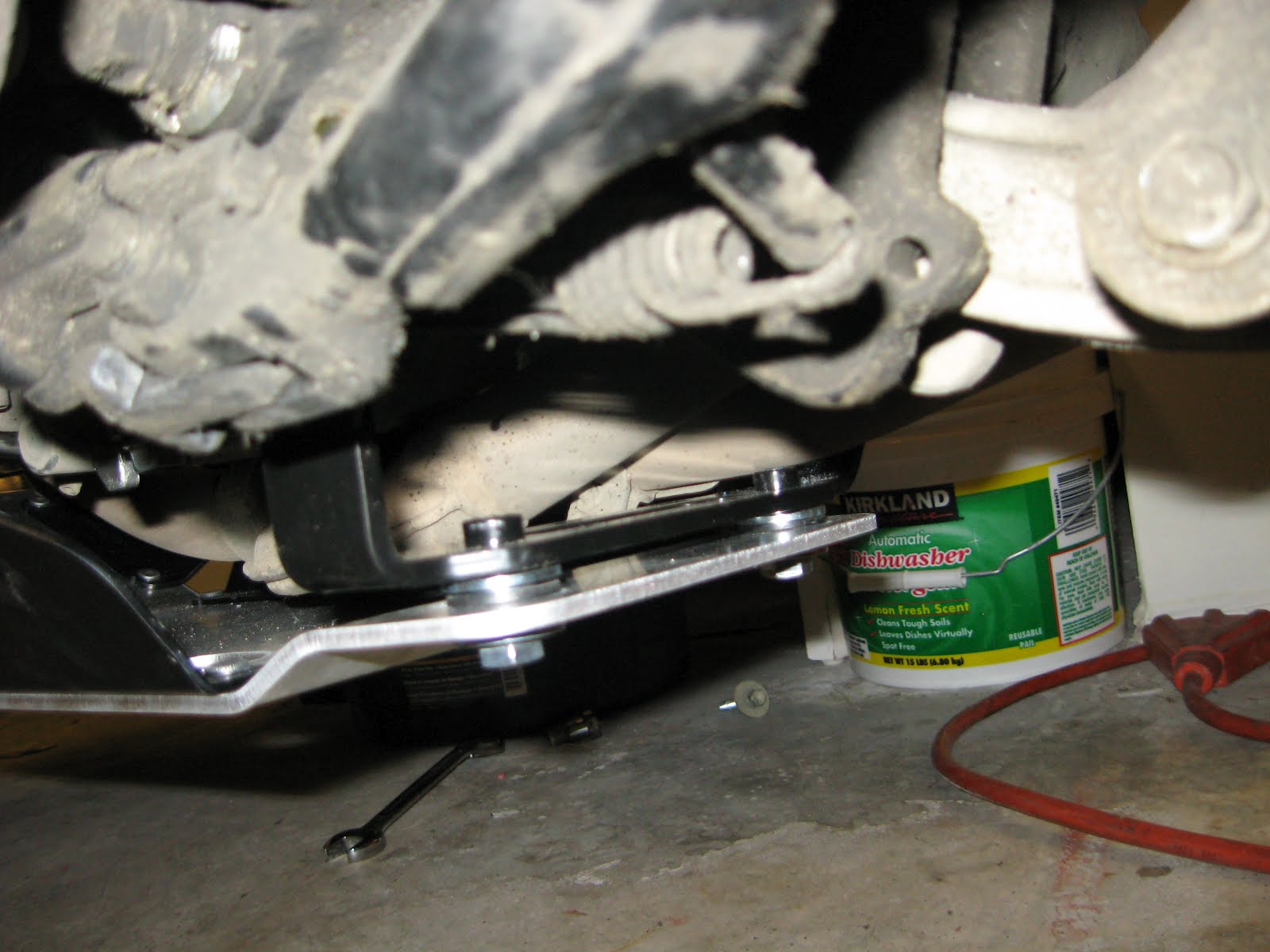
Here's photo of the bracket hanging from the kickstand mounts. The silver bar on the top left of the photo is the shifter; the odd-shaped black lump on the lower left is the kickstand.
Here's the other side of the bike, with the bracket attached to the exhaust hangar.
Put a little blue (medium) Locktite on the threads of the bolts, reinstall the kickstand, and tighten up all three bolts. Unlike the SW-Motech Evo side carrier racks, you can tighten these bolts up before continuing the installation.
There are two little metal pieces that look kind of like washers, only with small protrusions on each side (see the left photo above). Notice that one side is smaller in diameter than the other. Insert the smaller side into the rubber grommet in the front of the skidplate, leaving the wider diameter side pointing forward. The metal protrusion will fit into the plastic clamp holding the two sides of the SW-Motech crash bars together.
There is a similar washer-like piece that fits on the rear of the skidplate, except that it only has a protrusion on one side. Again, fit that protrusion into the rubber grommet.
Fit the two smaller bolts through the rear of the skidplate, through the metal washer-like pieces, and through the clamp on the crash bars. Install the nylock washers on the other side of the clamp, and tighten the bolts enough to hold the skidplate in position, but don't clamp everything down yet.
Now, take the two last bolts and the two last washers, and fit them through the rubber grommets and metal washer-things at the rear of the skidplate. Again, I used a little blue Locktite to keep the bolts from working loose while riding. If you need to adjust the positioning, you can rotate the crash bar clamp to move the skidplate forwards or backwards so that the rear bolts line up with the bracket. Then, once everything you've got everything lined up, tighten up the two rear bolts and the two front bolts.
Here's the completed install.
A couple of comments about the skidplate, now that I've got it installed: on the plus side, it looks very sturdy and very robust. I wish the Wee had a little more ground clearance, but the skidplate should help minimize the problems with clearance, since I would have to hit a rock or a stump pretty hard to damage the oil cooler or exhaust headers with the skidplate installed. On the negative side, SW-Moetch seems to have left a lot of empty space under the oil filter, oil pan and front of the headers, which only makes the ground clearance worse. The plumbing for the exhaust pipe sits a little lower than I expected where the rear cylinder headers join with the forward cylinder headers, and the skidplate has to be even lower than that. I suspect SW-Motech wanted to keep the skidplate as smooth as possible to allow the bike to slide over rocks, stumps and/or logs, but I still wish the front of the skidplate was fit a little closer to the engine. I guess you can always use the extra space to carry tools or water though!
I started by installing the rubber grommets in the skidplate. I presume they are being used as vibration isolators or shock mounts. Then I looked at the parts drawing trying to find the two 12mm washers that SW-Motech says should go over the bolts that hold the rear bracket to the bike. I couldn't find them, so I organized all the parts on a table in the garage. Nope, still can't find them. Then (finally!) I noticed the fine print on the drawing that says, "Original parts." Oh... <sheepish>
The next step is to remove the two bolts that hold the kickstand to the frame. Hey, wait a minute...how will the bike stay upright if the kickstand is removed? Okay, jack the bike up, and then remove the two bolts that hold the kickstand to the frame. By the way, those bolts are TIGHT; you will either need a really long-handled wrench or a cheater bar to break them loose.
The other side of the bracket attaches to the exhaust pipe hangar, just below the rear brake pedal. Unlike the kickstand attach bolts, the exhaust pipe hangar is really simple to remove.
Once all the kickstand and exhaust pipe hangar bolts have been removed, take the time to clean up the frame where the skidplate bracket will attach. The bottom of my Wee-Strom, at least, was caked with grime. If you mount the bracket without cleaning the frame first, you'll grit will grind away at the frame and the bracket.
Here's photo of the bracket hanging from the kickstand mounts. The silver bar on the top left of the photo is the shifter; the odd-shaped black lump on the lower left is the kickstand.
Here's the other side of the bike, with the bracket attached to the exhaust hangar.
Put a little blue (medium) Locktite on the threads of the bolts, reinstall the kickstand, and tighten up all three bolts. Unlike the SW-Motech Evo side carrier racks, you can tighten these bolts up before continuing the installation.
There are two little metal pieces that look kind of like washers, only with small protrusions on each side (see the left photo above). Notice that one side is smaller in diameter than the other. Insert the smaller side into the rubber grommet in the front of the skidplate, leaving the wider diameter side pointing forward. The metal protrusion will fit into the plastic clamp holding the two sides of the SW-Motech crash bars together.
There is a similar washer-like piece that fits on the rear of the skidplate, except that it only has a protrusion on one side. Again, fit that protrusion into the rubber grommet.
Fit the two smaller bolts through the rear of the skidplate, through the metal washer-like pieces, and through the clamp on the crash bars. Install the nylock washers on the other side of the clamp, and tighten the bolts enough to hold the skidplate in position, but don't clamp everything down yet.
Now, take the two last bolts and the two last washers, and fit them through the rubber grommets and metal washer-things at the rear of the skidplate. Again, I used a little blue Locktite to keep the bolts from working loose while riding. If you need to adjust the positioning, you can rotate the crash bar clamp to move the skidplate forwards or backwards so that the rear bolts line up with the bracket. Then, once everything you've got everything lined up, tighten up the two rear bolts and the two front bolts.
Here's the completed install.
A couple of comments about the skidplate, now that I've got it installed: on the plus side, it looks very sturdy and very robust. I wish the Wee had a little more ground clearance, but the skidplate should help minimize the problems with clearance, since I would have to hit a rock or a stump pretty hard to damage the oil cooler or exhaust headers with the skidplate installed. On the negative side, SW-Moetch seems to have left a lot of empty space under the oil filter, oil pan and front of the headers, which only makes the ground clearance worse. The plumbing for the exhaust pipe sits a little lower than I expected where the rear cylinder headers join with the forward cylinder headers, and the skidplate has to be even lower than that. I suspect SW-Motech wanted to keep the skidplate as smooth as possible to allow the bike to slide over rocks, stumps and/or logs, but I still wish the front of the skidplate was fit a little closer to the engine. I guess you can always use the extra space to carry tools or water though!
Subscribe to:
Posts (Atom)