Showing posts with label XS750 project. Show all posts

Tuesday, December 22, 2015

Miscellany

Mid-winter a few years ago, a co-worker asked, "What do you do for fun, once the riding season is over?" Having just acquired the XS750 project, I replied, "There are two seasons in Alaska: riding and wrenching." I don't like to waste my riding season working on the bikes, since the riding season is short enough as is, and invariably, once I start working on a bike, I'll end up with it off-line while I'm waiting for parts to arrive. On the other hand, I do enjoy tinkering on the bikes, so taking them apart to perform all the maintenance and upgrades during the off-season -- when I can't ride, anyway -- is a good way to spend the cold, dark winter months. To that end, I have thrown myself into work on all three of my bikes over the last two months.


In August, I rode my ultra-reliable V-Strom to work one morning, and noticed that it was acting funny while I was idling at a stop light. The turn signals were kind of flickering rather than blinking, and the engine seemed to be running rough, which is very unusual for that bike. I revved the engine a bit, and it settled down, leading me to think that I had a dead battery. That wasn't particularly surprising, considering that it's still the original battery -- six seasons old, now. After work, sure enough, there wasn't enough juice to start the engine. Fortunately, a co-worker was able to jump start me, and I made it home...but just barely. I needed the bike running ASAP, since our motorcycle organization had an event that weekend (this was a Thursday), so rather than taking the time to perform full diagnostics, I jumped to the most likely cause -- a dead battery -- and bought a replacement the next day. After work, I plugged in the new battery, started the engine, and connected a multi-meter to the battery terminals, reading 12.3VDC...not good. I should have been reading just over 14VDC. I took the Yamaha on the BACA event, then ended up ordering both a replacement voltage regulator and stator...at which point, I found that I also needed a gasket for the stator cover, since the V-Strom drips oil onto the stator to keep it cool. I believe I already mentioned something about invariably waiting for parts, once starting a maintenance project?

...all the while, I'm riding the 5000-RPM-idle cafe racer to BACA events...

...an hour away from home, one-way...

...in the rain.
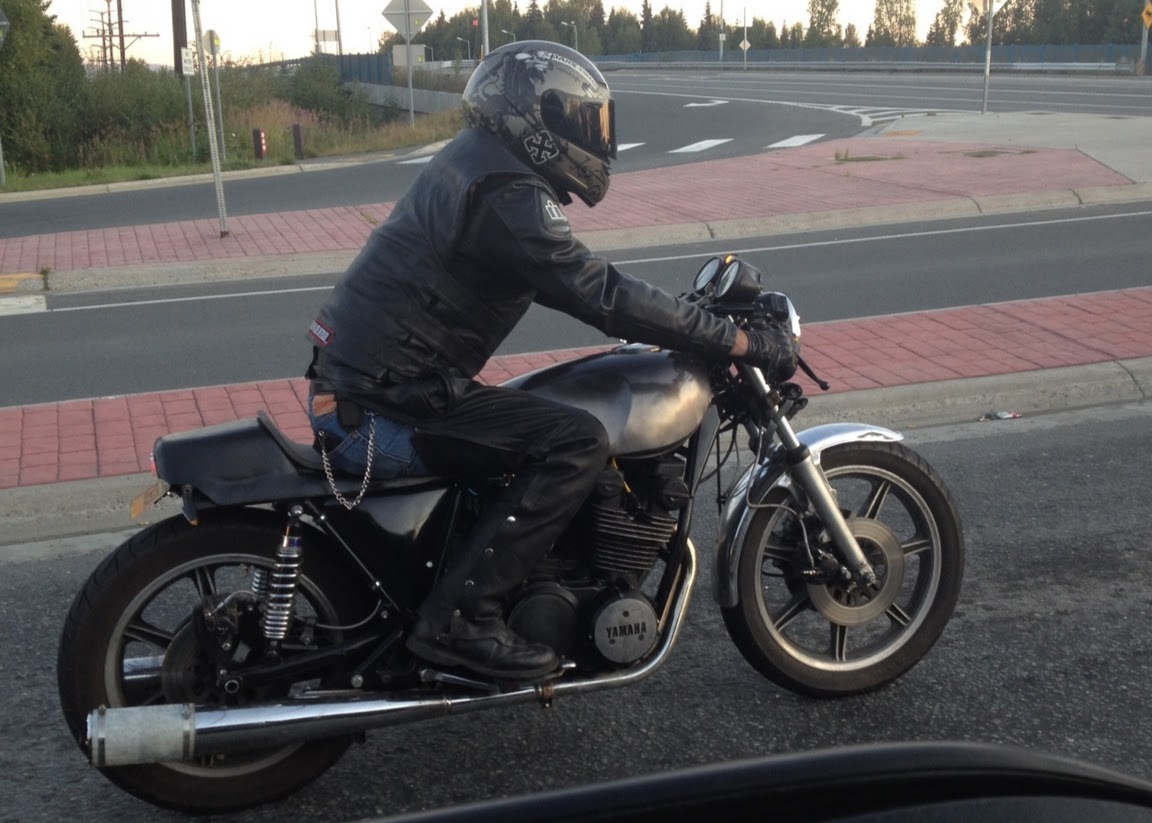

The cafe racer is a fun bike, but with clubman handlebars and NO fairing to protect from the weather, while wearing leathers only in the rain (no rain suit, because my orange nylon rain suit does not exactly scream, "I am a bad-*** biker, and can keep you safe from those who mean you harm") at maybe 40F...not so much.

I was really missing my fairing, my heated grips, and my heated jacket liner, lol (fine, I'm a wuss; what's your point?!?!)

Then, on yet another cold, rainy day on the cafe racer, I started having problems getting the bike into first gear. I could shift into neutral, second, third, etc., but I had a bear of a time getting the bike to downshift into first at intersections. In frustration, I parked the bike, and caged it with my wife to escort one of our BACA kids to court, then when I got the chance to check the Yamaha Triples web site, I discovered that the XS750's have a tendency to break the layshaft bolt, which then causes difficulty shifting into first gear.

Great...with maybe three weeks left in the riding season and BACA Anchorage getting busy working with kids, I had not just one, but *TWO* broken bikes. The whole point of having a second bike was to have an alternate in case a bike broke down!

With the Yamaha now out of service, I jumped into high-gear trying to get the electrical problems with the V-Strom sorted out, since fixing the charging system seemed like a more manageable task. Yeah...no. After finally getting it all put back together again, I took the Strom out for a 10:00 p.m. shake down ride. I was elated for the first eight miles, as the cheapie Amazon.com volt meter that I had plugged into the accessory electrical socket was showing a steady 14.4VDC while riding. Then all of a sudden, I noticed that my voltage was dropping: 13.7V...13.6V...13.5V...about a tenth of a volt per second, more or less. I quickly whipped a U-turn and raced back home...12.9V...12.8V...7.0V. Wait, what?!?! 14.0V...12.2V...13.1V...I started seeing wild voltage swings all over the place, and my LCD panel on the bike had gone completely blank. The engine was running rough again -- the ECU wasn't getting good voltage, so the fuel injection was getting squirrely -- and I just barely made it home (the bike died in the driveway). I opened up the bike -- AGAIN -- and determined that the brand new regulator/rectifier had failed. I parked the Strom, because quite frankly, I was completely fed up with it. I had sunk $450 in parts on the V-Strom in the last two months, and it STILL didn't work right. I spent the rest of the season riding my wife's CB750A to BACA events, and caging it to and from work, sigh.

Fortunately, this was the point that I found the GL1000 project, and I had so much fun working on this bike, that I eventually built up enough motivation to dig into the V-Strom again. Electro-Sport made good on their warranty of the regulator/rectifier, which I re-installed last night, and which now seems to be working properly.


Then, I managed to obtain spousal approval on a pair of Dime City Cycles mufflers for the Yamaha, which are now sitting in the garage, waiting for me to fabricate new balance tubes and connecting pipes to the existing headers. After that, I'll need to drain the oil and dig into the transmission case to replace the layshaft bolt. Oh, yeah...and I've got an envelope full of carburetor parts -- butterfly shaft screws, butterfly shaft seals, circlips, and springs -- for the XS750. Hopefully, those will resolve the high-idle problem on the cafe racer; if not...new carbs?

As for the GL1000...it needs a new voltage regulator, too. Unlike the V-Strom, the 'Wing uses a separate voltage regulator and rectifier, but most of the after-market units I have found seem to be integrated. Oregon Motorcycle Parts makes a reasonably priced unit that seems like it would fit the bill quite nicely, and in my initial conversations with them, they seem to be pretty good people to work with. I expect to have their VRRPM3H-GL1000 model on order in the fairly near future. After that, lower handlebars (so I can connect the front brake line), and a new battery...and the GL1000 should be running! I still want to replace the rear shocks with Hagon 2810 TTSA's, like I did on the Yamaha, and I'd like to order new side covers and shelter covers from E-Bay, because I'd like to go satin black on the 'Wing, but I don't want to ruin the original plastic, since it's in reasonably good shape. However, that's all wish-list material, not necessary-to-get-the-bike-running items ;)

Wednesday, November 11, 2015

Liter Bike!!!

As I've mentioned before, my very first motorcycle was a 1978 Honda GL1000 -- one of the original Goldwings -- with the engine in pieces.
Against my better judgment, I sold that bike before I ever got it running, and I've kicked myself ever since. Then, in March of 2010, I bought my Suzuki V-Strom
which has been a great bike, and which I've truly enjoyed.

However, I've run into a bit of a conundrum recently. About two years ago, my wife and I joined a motorcycle group that "...seeks to empower abused children to no longer be afraid of the world in which they live." My XS750 cafe racer,
while a lot of fun, isn't really ideal for riding with this group: it still idles at 5,000 RPM once it's warmed up, the exhaust is rusting to pieces (more on that in another post, coming soon to a web browser near you!), the rear view mirrors and tail lights are all but useless (which makes it kind of hard to keep an eye on the riders behind me -- or for them to interpret my intentions --when riding in a group), and I removed all of the provisions for carrying passengers. Making things worse, while my wife is a capable rider with a bike of her own (a pristine 1977 Honda CB750A Hondamatic)
it also has a few characteristics that make it..."sub-optimal"...for riding in our group. Although it's a very cool piece of history, it's not a terribly fast bike (yeah, it's a CB750, but the Hondamatics had a significantly de-tuned version of that engine) among other things. Consequently, she often rides pillion on my Suzuki V-Strom when we are riding with the group.

While I can ride two up in the group on the Wee-Strom, it too is less than ideal for this purpose. First, surrounded by a big-bore Kawasaki Vulcan, a Honda VTX-1800, several Harley-Davidson's (go figure), and a bunch of H-D trikes, the Strom sticks out like a very tall, bright orange, sore thumb.
It just doesn't look the part. More importantly, as much fun as it as when ridden solo, the Strom is a bit under-powered and under-sprung for riding two-up, especially when riding in a group of torquey, large-displacement cruisers. Finally, the brakes are a bit soft for carrying two full-grown, American adults at highway (ahem...) speeds. To solve this problem, my wife and I considered buying her a Sportster 1200 with a Frankenstein trike conversion kit but although it was a hoot to ride and would certainly have looked the part in the motorcycle group...well, it just wasn't a good fit.

We talked it over, and decided that maybe I should sell the V-Strom and buy a more capable two-up bike. After reviewing the options, I had narrowed the list of potential mounts down to a 2016 Suzuki Bandit 1250, a 2015 Triumph Speed Triple,
and a brand new, unsold 2013 Honda CB1100.
Once again, none of these bikes were quite right. The Bandit was the most practical choice, but would need suspension upgrades since they are reportedly undersprung, just like my V-Strom. The Speed Triple was the bike that set my pulse racing, but the passenger seat was a joke, the bars were really low for riding any length of time (although not as bad as my XS750), and I was worried about insurance costs on a hooligan bike like that. The CB1100 would probably be the most comfortable, but I didn't like the red paint, it had no windscreen, and while checking it out at the local Honda dealer, I was already making a list of modifications to make it more of what I wanted (read that, "$$$"). It would have worked, but it just didn't make sense to drop roughly ten grand on a brand new bike, then chop it up to re-make it the way I wanted.

No, none of these bikes were ideal, even if they were a step up from my V-Strom.

Then, the other night, my wife was looking at the bikes for sale on Craigslist when she found a 1978 GL1000 project. Hmmm...I like GL1000's...
Better yet, even after upgrades, the price is low enough that I wouldn't have to sell the V-Strom, and I've seen a couple of seriously cool GL1000 custom bike builds. I set out making a list of upgrades, changes, and simple maintenance items to make a vintage Goldwing suitable for our needs, and came up with the following preliminary list:

Item Justification Parts List Cost
Brake Rebuild The current owner already has removed the front brakes for a rebuild, and as I found with the XS750 project, neglected brakes are a nightmare. Rebuild these now before they end up in as poor shape as the front brakes on the Yammie were when I bought it. K & L brake caliper rebuild kits, K & L master cylinder rebuild kits, new brake pistons (cheap, and solves a lot of problems), braided stainless steel brake lines. $425
Dime City Cycles "Euro" Handlebars As I recall, the stock GL1000 handlebars aren't that bad -- way better than those evil monstrosities, invented by the ghost of Torquemada himself, that Yamaha shipped on the XS750 -- but I'd like something a little sportier. This would be a much lower priority change, but I really want to replace the old brake lines before riding season, and I'm not going to buy braided stainless steel brake lines twice for this bike. That's just a waste of money. Dime City Cycles "Euro" Handlebars $50
New Headlight Bike had a Vetter fairing; needs new lights and mounting hardware. E-Bay "Dominator" headlights and cafe racer fork ears. $140
Replace Timing Belts Cheap insurance. Bike has an interference engine. If a timing belt breaks, you will be tearing down the engine to replace pistons and valves. That's why the engine on my first GL1000 project was in several Rubbermaid boxes when I acquired it. Gates timing belts. $30
Uni Foam Air Filter Easy, inexpensive maintenance/performance upgrade item. Uni foam air filter $25
Ignition System Refurb Spark plugs are a no brainer. Coils and wires are relatively inexpensive and simple to replace, also. Finally, points and condensers wear out, giving a weak spark. Replacing these parts should make for a better running engine. DR8EIX spark plugs, coils t.b.d., 7mm silicone spark plug wires and NGK spark plug boots from Mike's XS, and a Sudco tune-up kit. $200
Suspension Upgrades Suspension is one of my key concerns. Vintage bikes are notoriously undersprung, and I've been happy with these springs and shocks on my XS750.
Note: I'd prefer Race Tech springs and valve emulators in the forks, but at 1/3 the cost, these win the cost/value argument.
Progressive Suspension fork springs and Hagon 2810 TTSA shocks. $414
Total: $1284


There are other things I'd like to change too, but this should be enough to get the bike to the point where it is reasonably reliable, comfortable, good looking, and capable of running with the best of them while two-up. I won't be schooling competent sportbike riders in the twisties on a vintage Goldwing, nor will I be the flashiest bike in the state, but this should be a vast improvement over the status quo. And, I'll get to regain some of that karma I lost when I sold my first GL1000 project, lol.

I'll go take a look at the GL1000 tomorrow, and who knows? Maybe by tomorrow night, I'll be the proud owner of yet another GL1000 project bike ;)

Edit: I bought the 'Wing:


There are a few maintenance items that need to be completed before it's ready to ride, but in all honesty, it's a very clean bike for its vintage. After looking it over, I've changed the planned maintenance slightly. There are a few things that have already been taken care of, and a few things that I probably won't change until after the bike is running (function first, cosmetics later -- a lesson I learned from the XS750 project). Here is a Google Sheets document outlining the plan in more detail. I'll leave the table above as a snapshot of the original plan, but the Google doc will be changing as work progresses.

Monday, July 6, 2015

Too Much Wrenching, Not Enough Riding!

I can't believe it's already July.

Summer came early to Alaska this year. Usually, it's the first week of May before enough ice has melted off my driveway for me to be able to get the bikes out; this year, I was commuting to and from work by mid-April. The weather since then has been phenomenal too, with June being a long series of clear, blue, sunny days with temperatures as high as I've seen them since I moved to Alaska some twenty-odd years ago.

So, of course, I spent most of the month of June laid up with an injury that kept me off the bikes entirely during the best two weeks of the month, and then spent the remainder of the month just commuting back and forth to work. I'm almost recovered now, but as a result, I have only taken the Strom out of town once this summer, for the B.A.C.A. 100 Mile Ride. Sigh...

However, even if I haven't been riding as much as I'd like, I've been making progress on the Cafe Racer project. After blowing the head gasket on the Yamaha triple last summer, I picked up a new engine gasket kit from Athena and rebuilt the top end of the XS750. While I had the engine apart, I borrowed an ultrasonic cleaner from a co-worker, disassembled the carburetors, and cleaned the carbs (again...) to try to solve the high idle problem I've been fighting since I bought the bike. After ultrasonically cleaning the carbs, I noticed a ridge of gum inside the carb where the butterflies close, so I did some heavy-duty cleaning on the inside of the carb and the outside edge of the butterflies with some 1500-grit sandpaper, but still can't get the bike to idle properly (grrrr...). I also tested moving the needle valve clip to the stock position (the center position of the five possible settings), but the bike feels like it lost off-idle response and stumbles upon initial throttle input now, so I'll be moving the needle valve clip back to one setting above stock (one setting more lean).

One minor problem I noted with the Cafe Racer last summer was that the front forks felt rather soft -- not surprising, since I have no idea if the fork oil had *ever* been changed. Consequently, I purchased a set of Progressive 11-1107 fork springs from Amazon.com, and rebuilt the forks this past weekend, which turned out to be a much simpler task than I expected, once I figured out a couple of tricks to getting the forks disassembled:

  1. Don't Remove the Forks Completely:
    To remove the fork guts, you'll need to remove a spring clip in the top of the fork. The service manual says to hold the fork tube in a padded vise, then depress the cartridge inside the fork to pop the spring clip loose. I didn't have a padded vise, but was able to make do by lowering the fork in the triple clamps until only about an inch of the fork stuck up above the lower clamp, then tightening the bolts on the lower clamp. Then I used this tool here...:

    ...to depress the cartridge inside the fork...

    ...so I could pop the spring clip loose with a small screwdriver like so:

    NOW go ahead and remove the forks completely for the rest of the work!
  2. Pry Out the Oil Seals from Underneath:
    The next problem I ran into was getting the oil seals out of the fork bottoms. I spent a while trying to dig the oil seals out from the top before finally using the biggest flatblade screwdriver I owned as a pry bar to pop the oil seals out from underneath. Set the blade of the screwdriver under the oil seal, then place the shaft of the screwdriver on the top of the fork. Press down on the handle until the oil seal rotates 90 degrees in the fork, then pull it out with your finger. Easy ;)
  3. Make Sure You Have New Dust Seals:
    I didn't pick up new dust seals before starting on the forks. The dust seal on the right-hand fork looked to be in decent shape, so it probably would be fine, but since the left-hand dust seal is cracked and in pretty rough shape, I'll probably just replace both...once I get a new set of seals...which means I'll have to remove the forks from the triple clamps again in a few days or weeks :roll_eyes:
  4. Don't Forget the Washer Between the Springs and the Pre-Load Spacers:
    Yep, I forgot to install my spacer, so I had to partially disassemble the forks again. Fortunately, this gave me the opportunity to snap the photos above, since I didn't take any pictures at all the first time ;)
  5. Use a Torque Wrench to Tighten the Triple Clamps:
    Otherwise, you end up with a problem like this:

    Yep, I over-tightened one of the bolts and sheared it in half. Fortunately, it was easy to drill out from behind, so tomorrow, I'll pick up four new bolts (might as well just replace them all) and finish up the fork work.

Really, those were the only significant "gotcha's." Everything else was pretty straight-forward. Progressive included a piece of plastic tubing to use to set your spring pre-load with their kit, which means you have to cut the tubing to size for your application. They give measurements for a number of bikes, but unfortunately, the XS750-2D wasn't one of them. However, the XS850 was, and the size recommended for the 850 (1 1/2 inch) was almost exactly the same as the difference in length between the OEM springs and Progressive springs, so I used that. I haven't had a chance to test ride the bike since installing the springs because I can't kick start the bike right now (the aforementioned injury that had me laid up for most of June), and I've removed the electric starter, so kick-starting is the only option for firing up the Yammie. However, once I get a chance to test ride the bike, I'll edit this post with an initial impression on whether or not 1 1/2 inches of pre-load was a good call.

I also might have to revisit the amount of oil I added to the front forks, since I was a bit confused by Progressive's instructions on the subject. After reading and re-reading the instructions, then trying to figure out how to use the Motion Pro fork oil measuring tool, I think I added the right amount of fork oil, but I'm not certain. Again, once I get a chance to test ride the bike, I'll adjust the oil level as required to get the compression and rebound damping reasonable.

Monday, June 29, 2015

Loud Pipes?

I've never been a "loud pipes save lives" guy. I believe paying attention and playing the "what-if" game ("what's the stupidest @#$&!!! thing another motorist around me can do, and what will I do when -- not if -- they do it?") are the best ways for a motorcyclist to keep him/her -self safe. I've also always held the opinion that being courteous when sharing the road was a good idea. I've often cringed when another motorcyclist with straight pipes rode by, worrying that non-motorcyclists would lump us all in the same group. To me, the "loud pipes save lives" crew has always seemed like they were trying to rationalize their unbaffled exhausts with a thin veneer of justification. However, I'm starting to think that I was wrong. Loud pipes might not be such a bad idea, after all.

So I'm on my way to work on my V-Strom the other day, cruising down a 45MPH, secondary road (two northbound lanes, two southbound lanes, and a suicide lane down the middle). I'm in the right-hand northbound lane when a dually work truck pulls out ahead of me. No problem; he's far enough ahead that I can slow down or change lanes to avoid him. There's a four door Jeep Wrangler in the left-hand lane, but I've got room to change lanes, so I do. About the time that I turn off my turn signal and get stabilized after changing lanes, some complete tool in the suicide lane pulls into my lane so effing close that there's no time for me to brake, and the work truck is still just slightly ahead of me in the right-hand lane, and not yet up to the speed of traffic. I do a quick assessment of my options (not many), and think to myself, "I'm not gonna avoid this one. This is gonna hurt."

Fortunately, my guardian angel (who has got to be mainlining Valium at this point in my life, and who is well past due for a promotion, lol) points out the one escape route I have available. Maybe. It's marginal, but the only other option I have is to go over the hood of the Escape or CR-V or whatever little SUV it was that pulled in front of me (identifying make and model was honestly not at the top of my priority list at this point), so I grab a fist-full of throttle, and go for it.

As it turns out, there was *just* enough room for me to lane split between the SUV and the work truck, even on my wide-butt Suzuki, and I managed to successfully slip between them before I rocketed down the road ahead of them, wanting to get as far as possible from the distracted driver in the SUV as fast as possible.

As readers of this blog will know, I've been trying to figure out how to repair the broken, obnoxiously loud exhaust on my Yammie for a while, but ya know...after this incident, I don't think I will, after all. I'll probably do enough work to clean up the cosmetics on the XS' exhaust, but no one has *EVER* been unaware of me on the (103+ dB) Triple, whereas on my (83dB) V-Strom, I've had more than enough close calls. In fact, I think I'm even going to retrofit my Strom to a louder can, as well.

I originally posted a slightly shorter version of this rant on one of the forums I frequent, and several people chimed in with various observations about the pros and cons of this plan, including some interesting things I hadn't thought of, like an anecdote about revving the engine on a louder bike to make sure that an obviously distracted driver knows you are there. Since, in our society, honking the horn is often used to express displeasure with other motorists rather than to politely get someone else's attention, revving an engine once or twice on a sufficiently loud motorcycle can draw others' attention to you without the baggage associated with honking your horn.

Others, of course, took issue with my decision to make sure my bikes were loud enough to draw attention to them, mostly due to the fact that being loud can be offensive to others. I get it. That's why I've ridden my Strom for six years already with the stock exhaust. That's why repairing the broken exhaust on my Yammie was such a priority for me. But here's the rub: I can't count the number of times I've had to take evasive action to avoid another motorist who obviously didn't see me. Some of them were merely annoying; I had options and was able to avoid the conflict by adjusting speed and/or position without much drama. Others were a little more memorable, like the teenager in the bright orange H2 Hummer who looked me in the eye, then pulled out Right...Freaking...In front of me (and then tailgated me after I swerved past him in the oncoming lane of traffic!!!) or the twenty-something punk that had a near-death-experience (although he didn't know it) after he cut me off with so little room to spare that I locked up my rear brake TWICE to avoid crashing into the rear quarter panel of his car. This year, however, I've had two instances where I really didn't think I was going to be able to avoid the accident. Fortunately, I was wrong both times, but these two incidents have shaken me up enough that I'm seriously re-thinking my stand on loud exhaust systems on motorcycles. As a good friend of mine recently said in a Facebook post, "An aftermarket exhaust is cheaper than your deductible." Hmmmm...that's actually a really good point!

If cagers are so self-absorbed and self-centered that they can't put down the cell phone for the twenty minutes it takes to get to work, can't be bothered to put on a turn signal before changing lanes, and can't be bothered to perform a head-check or even look in their rear-view mirrors before pulling into traffic, then I no longer care if my exhaust disturbs their Zen moment with Enya on their 1200 Watts of Dolby Surround Sound during their morning commute. My right to have a reasonable chance of arriving alive at my destination is just a little more important than your right to peace and solitude inside your insulated cocoon. Sorry.

So here's the deal: I'm going to try to find a louder-than-stock exhaust for my Strom that (hopefully) will drop the weight a bit (OEM exhausts are notoriously heavy), that (hopefully) will improve performance and/or gas mileage a bit, and that (hopefully) will garner a little more attention from other motorists when I ride. I'm shooting for something that won't be obnoxiously loud, but I definitely am looking for something louder than stock. From the evidence I've seen, motorcycles are all but invisible to other drivers; I'm tired of being silent (or close enough, anyway) as well.

[end rant]

Wednesday, December 10, 2014

Summer 2014 Wrap-Up

Despite the best of intentions, the 2014 riding season turned out to be somewhat anti-climactic.

Don't get me wrong -- it wasn't a bust by any stretch. I finally made it to Valdez, I got the Yamaha running well enough to put a few hundred miles on it, my wife and I participated in the Christmas in July charity ride, and Sue Zuki (the Strom) turned 30...thousand miles, that is ;) Unfortunately, I ended up trailering the Strom back from Valdez, the Yammy ended up with a pretty serious mechanical setback, and this year's Ride to Hope turned out to be the Ride to Girdwood due to some seriously foul weather.

Valdez: If you're in Alaska, whether living here or visiting, don't wait 25 years like I did -- it's really gorgeous through Thompson Pass and Keystone Canyon, easily one of the prettiest places I think I have ever been:
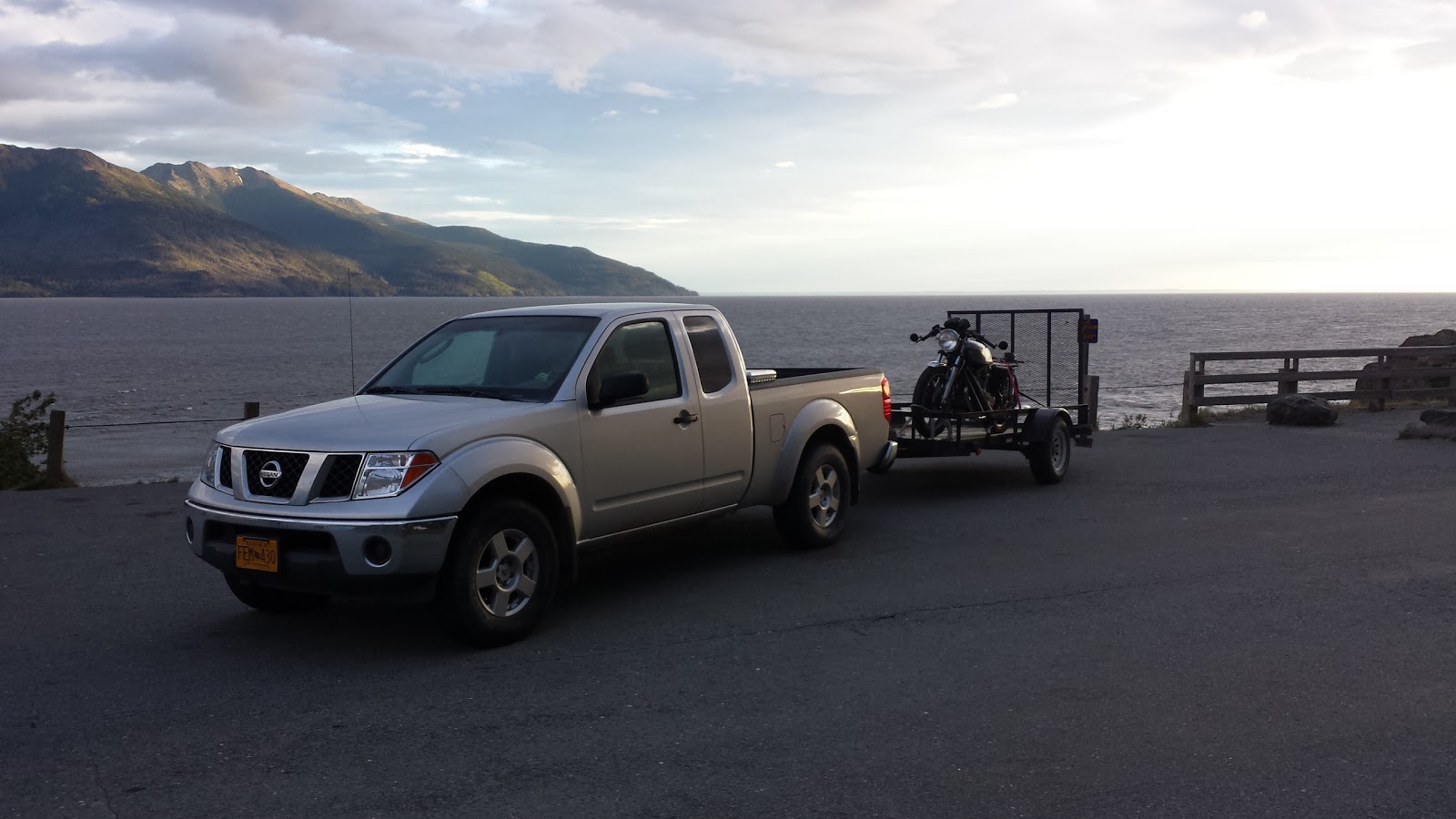
On the downside, I heard some odd noises from the rear wheel upon reaching Keystone Canyon on the return to Anchorage. Fortunately, my wife had driven our RV while I was riding the Strom, so I pulled the bike onto the trailer that my wife was pulling behind our RV, rather than riding all the way home. Oh, did I mention that it was pouring rain and bitter cold on the way to Valdez, but warm and sunny on the return trip? Adding insult to injury, the noises I heard in Keystone Canyon turned out to be nothing worse than a loose chain guard that had flopped over onto the chain, so the chain was lightly rubbing on the inside of the chain guard (sigh...) Despite the bad weather on the way to Valdez and the mechanical mishaps on the return trip, I honestly can't wait to go back again -- hopefully all the way there and back next time, lol.

Ride to HopeGirdwood: Then, there was the Ride to Hope, which turned out to be the Ride to Girdwood, due to the extremely inclement weather:
I typically ride rain or shine, so even though I was cold and uncomfortable, I wasn't going to say anything when we stopped in Girdwood to fuel up before heading the rest of the way to Hope. But...to be completely honest, I was not at all disappointed when the group decided to pull the plug on the ride. They headed back to Anchorage, while I snuggled up with a latte at the espresso shop there in Girdwood ;)

XS750 Project: Arguably my biggest motorcycle accomplishment this summer, I also got my XS750 Cafe Racer project running well enough to put about 800 miles on it, including a run to the bike show at the Alaska State Fair in Palmer.

Mechanical Gremlins: However, I didn't log nearly as many miles on my bikes this summer as I usually do, which I blame on persistent mechanical problems this year. Much as I hate to admit it, the V-Strom is starting to show some signs of its age. First, the front tire is nearly worn out, which is good because I <expletive deleted> hate the Continental Trail Attack tires I put on it last summer for the ride to Seattle. I've already replaced the rear with a Shinko 750, and I plan on doing the same thing to the front tire this winter. In fact, the front tire washed out on me once on my driveway this summer, leading to my first drop at any kind of speed, and destroying one of the fog lights I had hung on my crash bars a while back. I've already worn out the chain and sprocket I hung last summer (!), so I've got a replacement in the garage, waiting for me to get a chance to swap them out. And finally, the valves have started chattering a bit, telling me it's (well past) time to pull the plastic, remove the heads, and shim the valves. I'm not looking forward to that. I'm also starting to think that I should probably replace the battery (it's started acting a little less peppy than it used to be) and the brake lines (Suzuki recommends every four years; I'm at five, and I really want stainless steel lines, anyway).

Ok, no problem. The cafe-nated XS750 is running, so I should have been able to take the Strom off-line to work on it, right? Well...no. You see, I spent most of the summer tracking down a problem where the Yammie would run great for 20 miles or so, then would start running a little rough, would lose power, and then would die completely. I finally identified the problem as a plugged fuel vent, caused by my attempts to fabricate a new fuel cap gasket of silicone rubber last summer, and solved the problem (both of them) by buying a brand new, $25 gas cap -- money well spent!

Once I finally had that issue solved, I turned my attention to fabricating the bump-stop seat, which is 90% done now, although I'm not completely happy with it (it's heavy, a little rough in places, and the paint job looks like crap). I've also been trying out how to rework the exhaust system without paying a small fortune ($350, more or less) for a MAC 3-into-1 exhaust kit, which looks a little chintzy to me. I'd rather try to weld up a complete replacement, although I'll need to step up my welding skills to do that...and it's going to cost a lot more than the MAC. Finally, I've had the high-idle problem with the carbs all summer, as well. Trust me, you haven't lived until you've sat in traffic at a red light on a Yamaha triple with a blown-out exhaust system screaming at 4000+ RPM, lol.

Ok, so I spent a little while tweaking the remaining bugs out of the Yammy, some of which I still haven't completely eradicated, but it's still rideable, right? Ummm, no. On the ride to the Palmer State Fair, I blew the head gasket, and was only able to ride back home because a friend there loaned me a quart of oil to replace some of what leaked out all over my left leg and the engine case.

As a result of these mechanical issues, I didn't make some of the other trips I intended this summer. I skipped out on a group ride to Kennicot Mine, a number of group rides with the charity group that I'm in the process of becoming involved with, and I also blew off my hopes to ride to Nabesna this summer.

Project Plan: Needless to say, I've got a winter full of projects planned out for both bikes while the snow flies here in Anchorage:

Project Bike Dependencies
Head Gaskets Yamaha None
Valve Shim Adjustment V-Strom None
Carburetor Cleaning Yamaha None
Chain and Sprocket Change V-Strom None
Remove Starter Yamaha None
Finish Cafe Racer Seat Yamaha Match gas tank paint?
Exhaust R&R Yamaha Better Welding Technique, lol
Stainless Steel Brake Lines V-Strom None
Upgrade Regulator/Rectifier to Modern Yamaha None
Shorai Battery Both V-Strom: None;
Yamaha: Regulator/Rectifier Upgrade


Should be enough to keep me busy over the winter, lol. If I can get the first six items taken care of, I'll be content. If I can replace the V-Strom brake lines too, I'll be happy. If I can get the exhaust system repaired and/or replaced, I'll be ecstatic.

Friday, August 15, 2014

XS750 Project Part 25: On Rat Bikes, Abandoned Projects and Moving the Soul

I took an English class in college that was easily one of the biggest wastes of time in my entire college career. However, there was at least one grain of wisdom that the English professor teaching (ahem...) that class left with me: "A work of art is never completed," she said. "It is merely abandoned." Her point, of course, was that you can spend an entire lifetime rewriting, editing, altering, adjusting and perfecting your writing -- or any other art form, for that matter -- and there will still be something else in that work that you feel you can make better. Eventually, however, most artists (writers, painters, sculptors, whatever) grow tired with a particular piece of work, and move on to a new project.

Likewise, I have reached a point in my cafe racer project where, even though I know full well that the project is not complete, it is at least at a point where I can pull it out of the workshop and start enjoying it.

Don't be misled; it's still a rat bike in every sense of the word. The seat is a 1/2 inch thick sheet of foam rubber crudely carved (more or less) into shape and held on to the metal seat pan with bungie cords. The exhaust is shot and falling apart. The bike still idles at 4000 RPM once it has reached operating temperature, although I've got a lead on what needs to be done to fix that (thanks, Gatlyn!). The instrument cluster is dented, the triple trees are faded and rusting, and the idiot light panel is cracked and off-kilter. Nevertheless, it is at least ridable now, and I've been commuting around town on it every chance I get.

As I've said before, the V-Strom has been a great bike, and I am really glad that I bought it. It's rock solid, bulletproof, and as reliable as a bike can be. I've put just shy of 30,000 miles on it in the five summers I've owned it, and I fully intend to ride it into the ground; I don't expect that I will ever sell it.

However...have you ever had an itch where it doesn't matter where you scratch, you can't quite seem to reach it? You scratch here, but it's a little too low. You scratch a little higher, but that's not quite it either. You scratch to either side, but still miss the itch. Desperate now, you scratch all over, but every time, you get close...but not quite there. That's what the Strom has been like. It's a great bike, and I really enjoy riding it, but there's still something inexplicable that's missing when I ride it.

Then there's the Yamaha. Now that I've got it running, I think I've finally found what the V-Strom was missing: Character. Soul. That invisible, unquantifiable, visceral feeling of rightness that you can't explain to anyone else, but that you know and recognize the second it's there. The V-Strom is fast enough; in fact, I've ridden it about 10-20 MPH faster than I've (yet) gone on the Yamaha. It's a lot more comfortable than the Yam. I rode the Strom from Anchorage to Seattle and back, a round trip of 5,000 miles, at least according to the odometer (which, admittedly, includes commuting while in Seattle); the longest round-trip I've made on the bike I've named "Miami" ("My Yammy," lol) is 60 miles...and then I was a little stiff for two days afterwards! The Strom has never, ever stranded me anywhere (although I did trailer it back from Valdez this summer after what turned out to be a non-event -- the chain guard had loosened and was rubbing on the chain, but I thought it was bearing problems again), but I've had to call for a ride home once already while out on the Yammy, and I had to stop and troubleshoot on the side of the road once after the engine abruptly died on me. The Strom is more nimble, turns quicker and is more responsive to body language than the Yam. It also is lighter, has more range, carries more cargo, is more versatile, and starts with the push of a button every...single...time whereas the Yamaha is a cranky, cantankerous, kick-start-only machine, etc., etc., etc.

Yet somehow, despite all of the logical, rational, practical reasons why the Strom is a better bike -- and it is, no doubt about it -- the Yamaha still elicits more smiles per gallon than the V-Strom. When I want to unwind, it's the bike I gravitate towards, even in its present, unfinished state. When I close my eyes and picture myself shedding the stress of the day, the vision in my mind's eye is me astride the Yammy. The Strom transports the body, but the Yamaha transports the soul.

And in the end, that's why I ride. There's nothing logical or rational or practical about it. It's about feeding the soul and feeling alive. Both bikes fill needs that I have, so both bikes will continue to be ridden. Sometimes the mission will be practical, and I'll take the Strom. Sometimes the mission will be emotional, and I'll take the Yam. And if one or the other bike is down for maintenance, at least I won't be caging it during Alaska's all-too-short riding season ;)

Friday, June 20, 2014

XS750 Project Part 24: Brakes Working but Engine...Not So Much

For the second year in a row, I tried to have the XS ready for the Ride for Hope, a charity ride in which I like to participate. The cruiser crowd is usually well represented at the Ride to Hope, with a few large-displacement touring bikes in attendance as well. My Strom is typically an odd duck on this ride, as the Ride to Hope usually conflicts with the Dust to Dawson ride, and the ADV crowd usually opts for the D2D. No surprise, since Hope is only 80 miles from Anchorage -- barely a warm-up for ADV types. However, 80 miles would be a good run on a cafe racer, and I'm anxious to show off the XS, so I've been busy swapping out parts and trying to get the XS finished up in time for Saturday's (June 21) ride.

First, I found a pair of front brake calipers on E-Bay for a reasonable price, and managed to swap the new seals and stainless steel pistons out of the original calipers into the new E-Bay brakes. After a false start (I ended up needing to disassemble the calipers and take a brake hone to the cylinder), I finally got a pair of front brakes that no longer leak -- a major accomplishment, considering how many ways I've tried to repair the old calipers first. I wasn't happy with the stainless steel brake lines that run from the splitter to the calipers themselves, so I also ordered slightly longer Goodridge brake lines, and new bleeder check-valves (supposedly, they only allow fluid out, greatly simplifying the task of bleeding the brakes).

I also reworked the tail/brake lights and turn signals. I ended up cutting a few inches off of the metal seat pan to stiffen up the tail light/plate mount, since the old one seemed a bit flimsy and was too easy to bend.

I also spent some time working on a fiberglass seat and cafe hump to fit over the metal seat pan. After sculpting a gorgeous, work-of-art cafe hump out of florist's foam (if I do say so myself, lol), and laying up a couple of layers of fiberglass over the foam, I test fit the seat on the bike, and noticed that the hump was way too high for the lines of the bike. Over the winter, I found a post over at Bike Exif that describes the lines that make a good-looking cafe racer. The seat hump I had designed violated both the "Height" and "Swoop" guidelines in that post. I'm at least as much a rebel as anyone else, but...there's a reason those guidelines work, lol. I ended up taking my Lowe's dozuki saw knock-off to the hump, cutting it down so that it no longer looks out of place with tank on the bike. Unfortunately, there's still more finish work to be done on the seat before it's even close to being done.

Next, I replaced the stock vacuum-operated fuel petcocks with manual parts from Mike's XS, which solved the problem with fuel leaking from the tank. After several test runs in the driveway, then a quick ride in my neighborhood, I was satisfied that the petcocks were no longer leaking, that the carb floats were set correctly, and that they shut off the flow of fuel to the carbs properly once the float bowls filled.

Despite a persistent problem with idle on the bike -- once it warms up, it idles at 3500 - 4000 RPM and I can't figure out why -- I rode the bike to work one Friday morning. It started acting a little odd while sitting in traffic at lunch time, but ran great on the way home a few hours later, making me think that the engine was just getting a little too hot while idling at 4000RPM with no airflow over the engine. It is an air-cooled engine, after all. I installed new NGK BPR7 spark plugs while troubleshooting the high idle, mucked around with the idle mixture setting and idle adjust screw, but the bike still idled at 3500+ RPM. After reading everything I could find on-line about high idle on a carbureted motorcycle, I decided to add some Sea Foam to the tank, and run the bike on the highway for a while. As you can see in this video, the bike ran like a champ...

...until it abruptly stopped running altogether. After sitting on the side of the road for 10-15 minutes, I managed to get the bike restarted and limped back about two miles towards home before it died again. This time, I couldn't get it to start again, and I haven't been able to start it since (grrr!!!)

So, back out to the garage and more troubleshooting. I connected my ohmmeter to the primary leads of each ignition coil and measured the resistance. According to the fine folks at Yamaha Triples, the primaries on the '77 XS750 should measure 4 ohms +/-20%. I measured 6.5, 5.0 and 6.4 on coils 1, 2 and 3 respectively -- that's 62%, 25% and 60% out of spec, respectively. Then, I measured resistance from the primary to the output of each coil. Per the spec, that should be 11K ohms (+/-20%), and I measured 10.4K, 10.2K, and 10.5K on each coil, which is well within spec. Just to verify my tests, I also tried sparking from a plug to the engine ground while kicking the kickstarter -- it sparked, but didn't seem particularly strong. After testing the coils, I ordered replacements and new spark plug wires from Mike's XS as well as new points and condensers from Bike Bandit. We'll see if the makes any difference, but for now -- for the second year in a row -- the XS isn't quite ready for the Ride to Hope, so I'll be riding the Strom again. But at least *it* has heated grips! :)

Sunday, June 16, 2013

XS750 Project, Part 22 -- It Runs, But...

w00t!!! After wrenching on the bike all winter long, I fired the bike up the other day, and it runs!!! I had to adjust the idle to keep it from dieing if I took my hand off the throttle (which is the reason for the awkward point of view in the video), but that was an easy fix. However, if it's not obvious in the video, there's still a *LOT* of work to be done before I'm ready to ride off into the sun on the cafe racer. So, having yet another beautiful weekend to pull the bike out into the driveway, I started trying to address some of the remaining issues.

First, I CANNOT get the <many, many expletives deleted> LH front brake to quit leaking. I've tried crush washers, epoxy, and I even tried solder today to keep the brake fluid from weeping around the threads of the screw that I'm using to fill the bleeder hole, but nothing works. However, I came up with an ingenious solution, I think: remove the LH brake entirely. The rear brakes work and the RH front brake isn't leaking (knock on wood!) after filling the bleeder hole with epoxy, so I removed the LH brake. I'll see if I can find someone with a TIG welder to fill the bleeder hole with aluminum, but until then, I'm going to try having only one front brake.


Next, I needed to finish up the wiring on the rear of the bike, so after pulling the LH front brake, I set out to get the tail light/brake light and turn signals wired up. Unfortunately, I discovered two problems, once the wiring was done: the turn signals don't flash, and the front turn signals wouldn't light up at all. The flashing I understand, and the solution was (well..."will be") simple. The new turn signals don't draw as much current as the old turn signals, so I need a solid-state flasher. I had already bought a flasher to use with LED-based turn signals, but it wasn't compatible with my wiring harness. I didn't feel like wiring up a new harness, so instead, I went back to Superbright LEDs and ordered a compatible (I hope...) flasher. The second problem is proving to be a little more difficult to resolve. After poking around the wiring inside the headlamp housing for a bit, I discovered that the filament on one of the turn signals had broken. Remember, these are brand new turn signals, and when I originally bought them, I tried to remove the lamp to install an LED in its place, but failed. Having nothing to lose, I tried again to remove the lamp, this time being a little more aggressive, and I was, in fact, successful. Unfortunately, my local auto parts supplier didn't have a match for the tiny little bulb that was installed in the turn signal. Fortunately, Superbright LEDs had what I think is a match, so I will be replacing the bulbs with LEDs after all. My opinions on that are somewhat mixed, though. I wanted LEDs in the first place, but sheesh...I've never even used the friggin' turn signals and I'm already replacing bulbs(!). Honestly...I'm a bit torqued over it.

I also need to finish the seat before I can ride the bike, so I set out to remedy that problem, too. Originally, I intended to build something like a flat-tracker seat, which would allow me to carry a passenger. Then, I wanted to make a fiberglass solo cowl shaped like the archetypal cafe racer "hump" which I could install when I was by myself. However, relocating the license plate and lights above the seat pan changed my plans slightly. I decided to build a very small cowl that was more or less similar to the cowl that was originally installed on the bike, and possibly make a truncated cafe racer "hump" to fit over the vestigial cowl when I'm riding solo. To make the minimalist cowl, I used the same process I used to make the side covers:

Glue blocks of foam together with spray adhesive, and test fit on the back of the seat pan. Mark the outline of the license plate and tail lights with a Sharpie.

Lay out the shape of the front of the cowl. I used the old trick of marking evenly spaced dots along the vertical edge of the foam blocks, then an equal number of evenly spaced dots across the top edge of the blocks, and finally drawing straight lines to connect the dots on the sides to the dots along the top to approximate a curve. It worked beautifully, IMHO :)

Cut and sand to shape...

...cover with blue painter's tape...

...and paste wax to act as a release agent, then glass it up. I didn't shoot a photo of the first layer of glass, but I'll try to get some shots tomorrow or Monday, when I add another couple of layers (since this hump will be acting as a back rest for the passenger, I'll be using more layers of glass than the I used on the side covers to make it stiffer and stronger).

Finally, I started going through the bike, making some of the adjustments called out in the maintenance schedule, like adjusting the clutch and clutch cable, checking and adjusting throttle cable play, adjusting the idle setting (which I believe I mentioned earlier), etc. This fixed a problem I had noticed before firing up the engine the first time: pulling the clutch lever didn't seem to fully release the transmission. I couldn't move the bike in gear, even though I was pulling on the clutch for all I was worth.

Oh, yeah...one last issue. The starter button is 100% inop. I don't know if I really care, however, since I'd already considered removing the starter entirely. It's extra weight and necessitates a larger, more powerful (read: heavier) battery. On the flip side, it must have taken me 15 to 20 minutes to get it started the first time, lol. It's been better since then, but still nowhere near as easy to start as the push-button V-Strom :D For now, I'll probably ignore the problem with the starter button, but leave the starter motor in place. If I find that kick-starting the bike all the time is no big deal, I may look into pulling the starter and putting in a smaller battery next winter. If I'm fed up with kick-starting the bike this summer, on the other hand, I'll troubleshoot the starter button and leave the starter motor in place.

All in all, it was a good day, and I'm getting ever closer to taking the bike out for a spin. Man, I can't wait!